
Table of Contents
- Introduction: Why Salt Choice Matters for Your Health
- What is Sendha Namak (Rock Salt)?
- What is White Iodized Salt?
- Nutritional Comparison: Sendha Namak vs White Salt
- Health Benefits of Sendha Namak
- Health Disadvantages of White Salt
- The Iodine Dilemma: Why White Salt Still Matters
- Balanced Approach: How to Use Both
- Ayurveda’s Perspective on Salt Consumption
- Modern Research Insights
- Common Myths About Salt
- Practical Tips for Healthy Salt Usage
- FAQs
- Conclusion: Finding the Right Balance
Introduction: Why Salt Choice Matters for Your Health
Salt is an everyday kitchen ingredient, but not all salts are the same. In India, two types of salt dominate homes, Sendha Namak (Rock Salt) and White Iodized Salt. While most people use them interchangeably, Ayurveda and modern science both suggest that choosing the right salt can affect your heart, kidneys, thyroid, and overall well-being.
We will decode the benefits of Sendha Namak, disadvantages of White Salt, and how to balance iodine needs without harming your health. By the end, you’ll know the right way to include salt in your daily diet for a healthier lifestyle.
What is Sendha Namak (Rock Salt)?
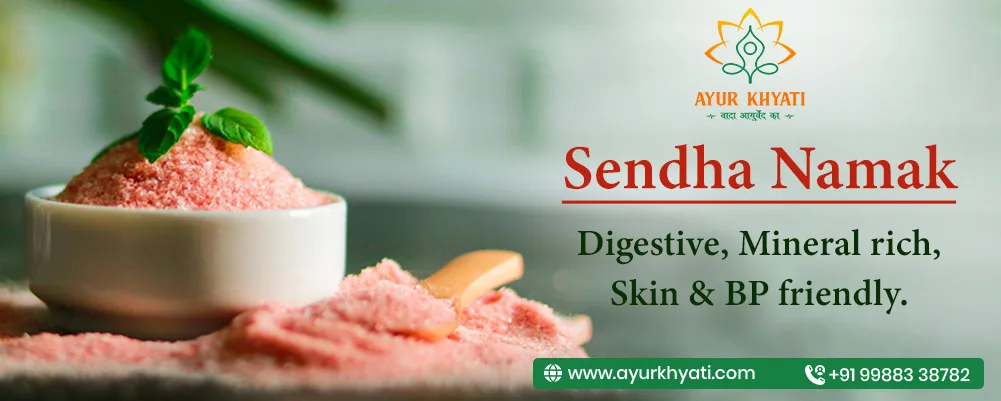
Sendha Namak, also called Saindhav Lavan in Ayurveda, is a naturally occurring salt found in rock deposits. Unlike processed table salt, Sendha Namak is:
- Unrefined and chemical-free
- Naturally crystalline in form
- Packed with trace minerals like magnesium, calcium, potassium, and zinc
- Lower in sodium compared to white salt
Ayurveda describes it as the purest form of salt that balances all three doshas (Vata, Pitta, Kapha) when consumed in moderation.
What is White Iodized Salt?
White salt, commonly called table salt, undergoes heavy refining and bleaching processes before reaching your kitchen. During this, many natural minerals are removed. To make it healthier, iodine is added artificially.
- Iodized salt is promoted by governments worldwide to prevent goiter and thyroid disorders.
- However, the bleaching agents and chemicals used during processing may have long-term health side effects.
While it provides iodine (essential for thyroid function), its excessive sodium and lack of other minerals raise concerns.
Nutritional Comparison: Sendha Namak vs White Salt
| Factor | Sendha Namak (Rock Salt) | White Iodized Salt |
|---|---|---|
| Source | Natural rock deposits | Processed sea salt |
| Processing | Minimal / none | High (bleached, refined) |
| Minerals | Magnesium, calcium, zinc | Only sodium + added iodine |
| Sodium content | Lower | Higher |
| Iodine | Naturally very low | Added artificially |
| Taste | Mild, earthy | Sharp, salty |
| Health risk (overuse) | Relatively lower | High BP, kidney strain, water retention |
Sendha Namak is natural, mineral-rich, and lower in sodium, while white salt is processed, high in sodium, and only provides iodine but increases health risks when overused.
Health Benefits of Sendha Namak
1. Supports Better Digestion
- Stimulates digestive enzymes
- Reduces bloating, acidity, and constipation
2. Rich in Trace Minerals
- Provides small but essential amounts of magnesium, potassium, and calcium
- Helps maintain electrolyte balance
3. Lower Sodium Content
- Reduces water retention and bloating
- Safer for people with borderline blood pressure issues
4. Beneficial for Skin and Respiratory Health
- Used in Ayurvedic therapies like salt gargles and steam inhalation
- Rock salt scrubs improve skin texture
5. Balances Doshas in Ayurveda
- Considered cooling and calming
- Recommended for daily use in moderation
Health Disadvantages of White Salt
1. Raises Blood Pressure
- High sodium levels lead to water retention and hypertension
2. Increases Kidney Strain
- Excess sodium forces kidneys to work harder
- Long-term use can lead to kidney stones and failure
3. Linked to Heart Disease
- Studies show high intake of processed salt increases risk of stroke and heart attack
4. Lacks Essential Minerals
- Refining removes natural minerals, leaving only sodium chloride
5. Chemical Residues
- Refining uses bleaching agents, which may leave harmful residues in the salt
The Iodine Dilemma: Why White Salt Still Matters
Despite its disadvantages, white iodized salt is important for one reason: iodine.
- Lack of iodine leads to goiter, thyroid imbalance, mental retardation in children, and infertility issues.
- According to WHO, iodine deficiency is a leading cause of preventable brain damage.
This means completely avoiding iodized salt can be harmful. The goal should be balanced consumption.
Balanced Approach: How to Use Both
- Use Iodized White Salt in your daily cooked meals (dal, sabzi, khichdi).
- Use Sendha Namak for table use (salads, papad, fruits, chaats, raitas).
- If you fast (vrat), Ayurveda recommends only Sendha Namak.
- Maintain daily salt intake < 5 grams per day (as per WHO guidelines).
This way, you get iodine for thyroid health + minerals from Sendha Namak without overloading sodium.
Ayurveda’s Perspective on Salt Consumption
- Ayurveda classifies salt under Lavana rasa (salty taste).
- Overuse leads to hair fall, premature greying, wrinkles, hypertension.
- Moderate use of Saindhav Lavan (rock salt) is considered best for daily health.
- Rock salt is especially recommended for people with Kapha and Vata imbalance.
Modern Research Insights
- A study in the Indian Journal of Medical Research shows that high sodium intake (>5g/day) increases risk of hypertension and kidney diseases.
- Research on rock salt indicates it provides trace minerals absent in processed salt, supporting metabolic health.
- However, iodine supplementation is necessary in India due to naturally iodine-poor soils.
Common Myths About Salt
Myth 1: Sendha Namak is completely iodine-rich.
Truth: It has very little iodine, not enough to prevent thyroid disease.
Myth 2: White iodized salt is always harmful.
Truth: In small, balanced quantities, it is essential for thyroid health.
Myth 3: Pink Himalayan salt and Sendha Namak are different.
Truth: Both are varieties of rock salt, though mineral compositions differ slightly.
Practical Tips for Healthy Salt Usage
- Limit packaged/processed foods, they hide excess salt.
- Cook with iodized salt, garnish with rock salt.
- If you sweat a lot (athletes, laborers), rock salt water can help replenish electrolytes.
- Patients with BP, kidney, or heart disease should consult an Ayurvedic doctor for salt recommendations.
FAQs
Which salt is healthier: Sendha Namak or White Salt?
Can I completely replace white salt with Sendha Namak?
Is Sendha Namak good for high blood pressure patients?
How much salt should I consume daily?
Does Sendha Namak help in weight loss?
Conclusion: Finding the Right Balance
Salt is necessary for life, but the type and quantity of salt you use determines whether it heals or harms.
- Sendha Namak provides natural minerals, aids digestion, and is safe for moderate use.
- White Iodized Salt prevents thyroid problems but can cause BP and kidney strain if overused.
The best solution is a balanced approach, cook with iodized salt for iodine, and use rock salt for salads and table consumption.
At Ayur Khyati, Gujarat, our Ayurvedic doctors guide patients on holistic diet and lifestyle choices, including the right way to consume salt for better health, digestion, and disease prevention.
Contact us at +91 9988338782 to book your Ayurvedic consultation.